


Ningbo Doto Electric Co., Ltd.

Ningbo Doto Electric Co., Ltd.
A thermal overload relay is the component that stands between a healthy motor and a burnt-out one. Where a circuit breaker protects the cable against short circuits, the overload relay watches the current the motor draws and trips when that current stays above the set value for too long. The distinction matters: a motor can run at 115% of its rated current for a while without damage, and a device that trips instantly at that level would stop every legitimate start. The relay has to be slow enough to ride through normal starting inrush and fast enough to disconnect before the winding insulation fails.
Inside the Doto LR2-D series the sensing element is a bimetal strip heated directly by the load current. As current rises above the dial setting, the strip bends progressively and releases a trip bar. Because the movement is thermal rather than magnetic, the trip time shortens as the overload grows - roughly the inverse-time curve described in IEC 60947-4-1. The same bimetal assembly also responds to a lost phase, which is why a relay with phase-failure protection is worth specifying rather than treating as an optional extra.
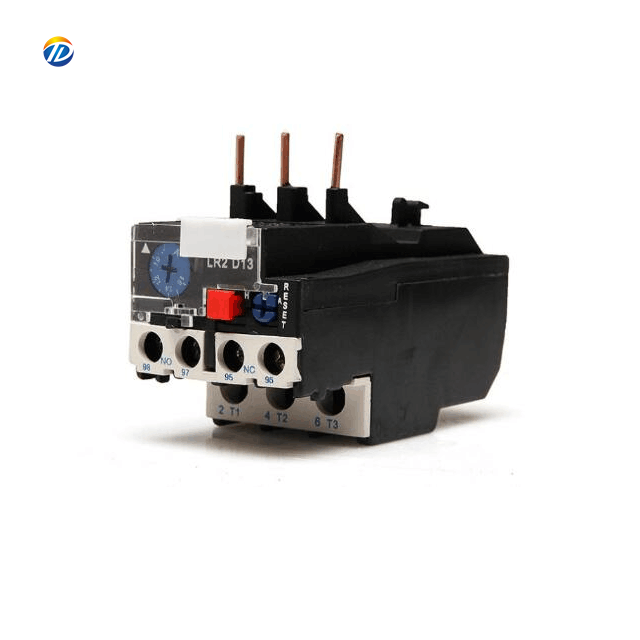
The single most common ordering mistake is buying a relay whose setting range does not bracket the motor's full-load current. A relay rated 12-18 A cannot be set to protect a 9 A motor, and forcing it to sit at the very bottom of its range leaves no adjustment margin. The correct approach is to work from the motor nameplate: take the full-load current at the actual supply voltage, then pick the narrowest range that contains it, ideally with the set point falling in the middle third.
Doto covers the small-to-medium motor range across four frames, so a single relay family handles almost every panel requirement:
Note that the D23 and D33 overlap between 23 A and 36 A. That is deliberate: the D23 suits a 30 A motor on a CJX2-32 contactor, while the D33 is chosen when the same motor sits on a larger contactor for a higher switching duty. Selection follows the contactor, not only the current.
Trip class defines how long the relay takes to trip at six times its set current. Class 10 trips within 2 to 10 seconds and suits ordinary motors, pumps and fans that accelerate quickly. Class 20 extends that window to 4 to 20 seconds for heavy-starting loads such as crushers, conveyors and high-inertia fans, where a Class 10 relay would trip during every start. Class 30 is used for very high inertia loads and is a special-order item in most ranges.
Selecting a heavier class to "avoid nuisance tripping" is a common shortcut that quietly removes protection: the motor is allowed to run overloaded for twice as long. If a Class 10 relay trips on start, the real problem is usually a starting time close to the limit, an undersized contactor, or a set point at the bottom of its range - not a need for a slower class.
The relay mounts directly onto the load side of the contactor, and the three main circuit terminals pass through the bimetal heaters. Two installation details account for most warranty questions. First, terminal torque: a loose main terminal adds resistance and heat, which the bimetal reads as overload, so the relay trips at a current well below its setting and the fault is blamed on the relay. Second, ambient temperature: the trip point shifts with the temperature inside the enclosure, and a relay calibrated at 20 degrees Celsius behaves differently in a sealed cabinet at 55 degrees. Where panels run hot, either derate the setting or compensate as the relay manual specifies.
All four Doto frames provide a manual and auto reset selector plus one normally open and one normally closed auxiliary contact rated Ith 10 A. Auto reset suits unattended equipment where a momentary overload should not stop the process permanently; manual reset is the safer choice when a trip indicates a fault that a technician should inspect. Wiring the normally closed contact into the contactor coil circuit is what actually removes the motor from the supply - the relay alone only signals.
Buyers increasingly ask whether a motor protection circuit breaker can replace the contactor-and-relay combination. The answer depends on what the panel must do. A motor protection circuit breaker combines short-circuit and overload protection in one device and saves space, but it does not provide remote control of the motor, and its overload element is not always adjustable across as wide a range as a dedicated relay. In a star-delta or soft-starter circuit, the relay remains the practical choice because it sits in the motor circuit and follows the actual winding current.
Where both are fitted, the division of labour is clear: the breaker clears short circuits, the relay handles sustained overload and phase failure, and the contactor does the switching. Setting the relay above the breaker's magnetic trip threshold, or the breaker below the motor's starting current, inverts that logic and produces a panel that trips for the wrong reason.
Three facts let us confirm the correct part in a single exchange, and they are worth putting on the inquiry rather than on a later email: the motor's full-load current at the supply voltage, the contactor model the relay will sit on, and the trip class required by the application. Supply frequency and ambient conditions are useful additions when the destination is a hot climate or the panel is enclosed.
Details of each frame, including setting ranges, matching contactors, dimensions and standards, are on the individual product pages linked from our thermal overload relay range. If you are still deciding between an overload relay and another protection strategy, the guide to selecting the right AC contactor explains how the contactor frame and the relay are chosen together - the two decisions are rarely independent.
Last: Why AC Contactors Fail: Chatter, Welded Contacts, Burnt Coils
Next: MCB or RCCB? Understanding the Difference Before You Order
Send us your inquiry — quotation and reply within 24 hours.
Professional manufacturer of AC contactors, circuit breakers, capacitors, hour meters and counters. Factory-direct, CE & ROHS certified, exporting worldwide.
 Search
 WeChat
 Top